FROM THE TRUSTEE
The Work After the Valuation
By this point in the year, most calendar-year ESOP companies have completed their annual valuation, participant statements have been distributed, and Form 5500 work is either complete or approaching its extended deadline.
That does not mean the ESOP work is finished.
Fall is when management has an opportunity to look forward. What did this year’s valuation tell us about the business? How are actual results comparing with the projections provided to the appraiser? What distributions and repurchase obligations are approaching? What will the company need to fund in 2027? And are there developments in the business that the trustee should know before the next annual valuation begins?
Those questions matter because an ESOP does not operate independently of the company. Capital expenditures, acquisitions, debt, management changes, customer concentration, distributions, repurchase obligations, and operating performance can all affect the plan and its participants.
Good ESOP governance is a year-round process, not an annual valuation exercise. As we move into the final quarter of 2026, this is the right time to turn this year’s results into next year’s plan.
William J. Kropkof, CEBS, Independent Fiduciary, ERISA Advisory Group
“The annual valuation tells us where the company has been. Good fiduciary governance requires us to understand where it is going.”
WHAT WE’RE WATCHING
Employee Ownership Has Washington’s Attention
The federal policy environment around employee ownership continues to evolve. While none of these developments changes the fundamental fiduciary duties governing an existing ESOP, they show meaningful bipartisan interest in expanding access to employee ownership.
SEP 2026
U.S. SENATE
Retire Through Ownership Act Passes Congress
On September 16, 2026, the U.S. House of Representatives passed the bipartisan Retire Through Ownership Act (S. 2403), following earlier passage by the Senate. The legislation now heads to the President for signature.
The legislation addresses ESOP valuation by providing that an ESOP fiduciary may rely in good faith on an independent valuation expert or business appraiser using established IRS valuation principles and methodologies. It does not modify a fiduciary’s duties under ERISA Section 404.
What it means: If enacted, the legislation would provide additional statutory clarity around the ESOP valuation process and fiduciary reliance on qualified independent valuation professionals, while preserving the trustee’s underlying fiduciary responsibilities.
2026
CONGRESS
Lawmakers Target the ESOP Financing Gap
The American Ownership and Resilience Act, introduced as H.R. 3248 and S. 1645, proposes a new mechanism intended to increase private capital available for employee ownership transactions.
The legislation would create federally supported Ownership Investment Companies designed to help address the financing gap that can arise between conventional senior bank financing and the total capital needed for an ESOP transaction.
The legislation remains a proposal, not a financing program companies can currently access.
2026
ESOP LENDING
The Financing Market Is Evolving Too
Outside Washington, ESOP financing itself continues to evolve. More banks have developed dedicated ESOP lending capabilities, and some lenders are using tiered or delayed-draw structures that provide additional borrowing capacity when companies satisfy specified financial covenants.
For existing ESOP companies, the broader lesson is relevant even if a new transaction is not contemplated: capital structure, debt capacity, cash flow and ESOP obligations should be evaluated together rather than independently.
THE BIGGER PICTURE
Federal support for employee ownership is encouraging. But increased attention to ESOPs does not reduce the fiduciary standard. Growth in employee ownership and rigorous fiduciary oversight should move together.
YEAR-END ESOP CHECKUP
Five Questions Management Should Be Asking Before 2027
01. How Did Actual Performance Compare With the Valuation Projections?
Pull out the projections used in the most recent valuation and compare them with actual year-to-date results.
Look at:
- Revenue
- EBITDA and margins
- Major customers
- Backlog or pipeline
- Working capital
- Debt
- Capital expenditures
- Material changes
A variance does not necessarily mean something is wrong. What matters is understanding why performance differs and whether the change is temporary, structural or likely to affect future expectations.
02. What Has Changed Since the Last Valuation?
Consider whether the company has experienced:
- A major customer gain or loss
- Acquisition or disposition activity
- New financing or refinancing
- Significant litigation
- Leadership changes
- Material capital expenditures
- Changes in compensation arrangements
- Significant new contracts
- Changes in the competitive environment
Do not wait for the next valuation data request to identify a significant development.
03. What Will the ESOP Require From Cash Flow Next Year?
Estimate upcoming:
- Participant distributions
- Diversification payments
- ESOP contributions
- Debt service
- Repurchase obligations
Then consider those obligations alongside ordinary operating requirements.
04. Is the Company’s Repurchase Forecast Still Realistic?
A repurchase study should not simply sit on a shelf.
Changes in the workforce demographics, turnover, retirement patterns, share value and distribution elections can materially change future cash requirements.
Federal law gives participants in closely held ESOPs a put option requiring distributed shares to be repurchased at fair market value, which is why forecasting the obligation is important.
05. What Does the Trustee Need to Know?
One of the simplest governance practices is also one of the most valuable:
Communicate material developments before they become surprises.
The trustee’s role is not to operate the company. It is to understand developments that may affect the ESOP and exercise independent fiduciary judgement on behalf of participants.
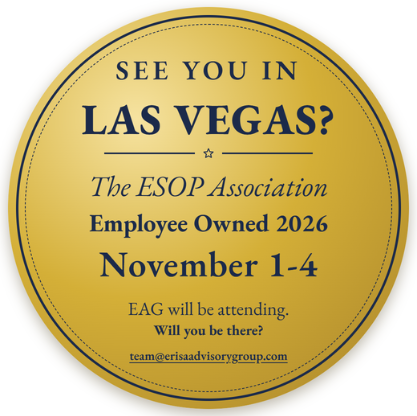
WILL WE SEE YOU AT EMPLOYEE OWNED 2026?
We would love to see you there
The ERISA Advisory Group team will be attending The ESOP Association’s Employee Owned 2026 Conference, November 1-4 at ARIA in Las Vegas.
If you or others from your organization will be attending, we’d love to connect with you while we’re there.
Let us know you’ll be there:
team@erisaadvisorygroup.com
Learn more about Employee Owned 2026:
https://www.esopassociation.org/events/employee-owned
THE 2027 VALUATION STARTS NOW
Better Information Creates a Better Process
Companies sometimes think of the annual ESOP valuation as something that begins when the appraiser sends the information request. In reality, much of the information that will drive the next valuation is being created right now.
The 2027 Valuation File
Management should begin preserving the story behind 2026 results.
Financial Performance
Document significant variances from budget and prior-year results.
Projections
Be prepared to explain the assumptions behind the next forecast and how those assumptions compare with historical performance.
Customer Changes
Document major wins, losses, renewals and concentration changes.
Capital Structure
Track new borrowing, refinancing, debt repayment and significant changes in liquidity.
Management & Workforce
Identify material leadership changes and significant workforce developments.
Strategic Developments
Document acquisitions, new locations, major contracts, product expansions and other developments affecting future performance.
Why Documentation Matters
The DOL’s published ESOP process guidance emphasizes written support for material assumptions underlying projections, adjustments to financial results, valuation methodology and the financial effect of ESOP obligations.
That gives management, the appraiser and the trustee a cleaner record when the next valuation process begins.
“Do not reconstruct the story of 2026 six months from now. Document it while it is happening.”
PLAN SPONSOR BRIEFING
Your Q4 ESOP Calendar
For calendar-year plans, the final quarter brings several items worth keeping on management’s radar.
OCTOBER 15
Extended Form 5500 Deadline
For calendar-year plans that timely requested the standard extension, October 15 is generally the extended deadline for the prior year’s Form 5500. Confirm that the filing is complete and that information across the Form 5500, audit and plan records is consistent.
FALL
Summary Annual Report
For plans required to provide an SAR, make sure participant disclosure timing is being tracked following the Form 5500 filing.
Q4
2027 Budgeting
Incorporate known ESOP-related cash requirements into the company’s budget, including anticipated contributions, distributions, repurchase obligations and ESOP debt service.
Q4
Governance Review
Before year-end, confirm:
- Trustee and company records are current
- Board and committee actions are properly documented
- Unresolved valuation or administrative items are closed out
- Material corporate developments have been communicated
- Distributions and diversification elections follow plan terms
BEFORE YEAR-END
Prepare for the Next Valuation
Start assembling the information that explains 2026 performance and supports 2027 projections.
A SIMPLE YEAR-END QUESTION
Could someone unfamiliar with the company read this year’s records and understand why the important ESOP decisions were made?
If the answer is yes, you are probably building the kind of record a fiduciary process should produce.
If the answer is no, year-end is a good time to close those gaps.
FOR YOUR PARTICIPANTS
A New Q3 Participant Resource
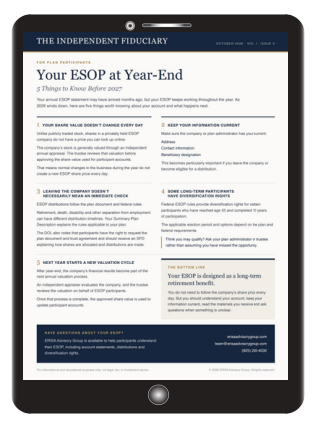
This quarter’s participant communication, “Your ESOP at Year-End: 5 Things Employee-Owners Should Know Before 2027,” explains what happens after annual statements are distributed, why account values do not change throughout the year like a publicly traded stock, what employees should keep updated, how distributions and diversification work, and what to expect as the next annual ESOP cycle begins.
DOWNLOAD THE GUIDE
Contact team@erisaadvisorygroup.com for a copy.
Meet your Author
William
Kropkof

Independent Fiduciary
William Kropkof is the founder of ERISA Advisory Group, established in 1995 to help businesses build ERISA-compliant Employee Benefit and Retirement Plans. Before entering the private sector, he spent seven years as an Investigator with the US Department of Labor, auditing employers and enforcing ERISA compliance. That hands-on regulatory experience now informs his work as an Independent Fiduciary, serving clients across industries including Trade Associations, PEOs, and Taft-Hartley Unions.